Increased Attention To Dry Cleaners Likely Under New Property Due Diligence Requirements

Written by Steve Henshaw, President & CEO, EnviroForensics

As seen in the December 2013 issue of Cleaner & Launderer

PDF Version

On November 6, 2013 ASTM E1527-13 became official as the guidance standard used by environmental consultants for conducting Phase 1 Environmental Site Assessments.  Environmental Site Assessments are required by banks and lenders before those entities loan money on real estate holdings and they are designed to identify potential or existing environmental liabilities associated with the subject properties.  The reason that this is important to dry cleaners is that the new guidance puts greater emphasis on assessing the potential impacts from vapor intrusion and vapor migration on the property.  In fact, the definition of a “release” within the guidance has been changed to include contamination in the subsurface vapor phase, in addition to the soil and groundwater.

Continue reading “Increased Attention To Dry Cleaners Likely Under New Property Due Diligence Requirements”

DEALING WITH THE PERCEPTION OF RISK; THE VALUE OF HAVING AN EFFECTIVE COMMUNICATIONS PLAN

Written by Stephen Henshaw, P.G., President & CEO, EnviroForensics
As seen in the October 2013 issue of Cleaner and Launderer

Over the years, environmental regulations have gotten more and more restrictive.  The permissible levels of chlorinated solvents in groundwater, soil and indoor air continue to be pushed lower.  While the acceptable level of PCE in indoor air was actually increased by the federal government, the acceptable level of TCE (a breakdown product of PCE) was drastically lowered, which has resulted in an increase of Sites posing a public health risk.  It is the vapors, which contain volatile organic compounds from releases of cleaning solvents or gasoline, which is posing the greatest risk to people living or working near the Sites where the contaminants were released.  The regulatory requirement to evaluate the fate and distribution of these contaminated vapors into homes, apartments, schools, and businesses is raising the publics concern and could create the perception of risk and with those perceptions associated concerns and fears of health effects.

Continue reading “DEALING WITH THE PERCEPTION OF RISK; THE VALUE OF HAVING AN EFFECTIVE COMMUNICATIONS PLAN”

Cradle to Grave Responsibility And Long-Tail Liability

Written by Stephen Henshaw, P.G., President & CEO, EnviroForensics
As seen in the September 2013 issue of Cleaner & Launderer

Most people that purchase, handle and manage cleaning solvents, are familiar with the terms “Cradle to Grave Responsibility” and “Long-Tail Liabilities”.  Cradle to Grave responsibility has been used to describe the fact that any person that generates a waste material that is classified, as a hazardous substance is responsible for that waste from the time it is generated until pretty much the end of time.  The Cradle to Grave system is a provision with legislation known as the Resource, Conservation and Recovery Act (RCRA) which passed in 1976 and focuses to a large degree on the management of hazardous waste. There is no time limit or expiration date that will release a generator from this long-term management responsibility.  This is why the management of hazardous substances is termed Long-Tail Liability.

Everyone knows that when a site is contaminated, the person that caused the contamination is responsible for cleaning it up.  But what happens when the party that operated the site is no longer around, either financially or administratively.  Who then pays for the cleanup? Continue reading “Cradle to Grave Responsibility And Long-Tail Liability”

Long-Tail Environmental Liabilities; That’s Why You Bought Insurance

Written by Steve Henshaw, P.G., President & CEO, EnviroForensics
As seen in the June 2013 issue of Cleaner & Launderer


Last month over 200 active or former dry cleaners received a letter from the State of California informing them that if they would pay money to the State, the State would settle a claim against them for contributing to environmental contamination at a long closed out solvent recycling and waste management facility.  The drycleaners followed the law and sent waste solvent and filters to a hazardous waste management facility that was licensed by the State of California to handle such material.  As part of having a license to operate, this facility was required to have a cleanup bond to pay for the removal of stored material and the cleanup of environmental contamination at the site.   Should they shut down and walk away before such cleanup activities were completed.

While this particular situation seems unfair, I assure you that it is not uncommon.   Whether it is the government, or a neighboring property owner, or a new owner of the site, environmental liability does not go away.  Environmental contamination can lay dormant for years, even decades, but at some point, more often than not, it gets cleaned up and somebody has to pay for it.  And when somebody has to pay, even if that somebody is the government, those that owned or operated the facility that generated, transported or disposed of the hazardous waste, contributing to that contamination, can be held liable for the cost of investigation and cleanup.

Today I want to tell you once again about long-tail liabilities and how they won’t go away.  In fact, like taxes, the environmental statutes were written so that they would not be discharged or forgiven through a bankruptcy, ownership transfer, possibly even estate probate.  Continue reading “Long-Tail Environmental Liabilities; That’s Why You Bought Insurance”

PREFERENTIAL PATHWAYS; UNDERGROUND PIPES AND UTILITY LINES CAN BE CONDUITS FOR THE MIGRATION OF CONTAMINANTS

Written by Stephen R. Henshaw, P.G., President & CEO, EnviroForensics

As seen in the March 2013 issue of Cleaner & Launderer

PDF Version

You can imagine that if wastewater is discharged into a sewer line with cracks in it that the wastewater could contaminate the soil and groundwater.  After all, sewer pipes can be very old and made of a variety of material such as transite, clay, concrete, plastic, or steel.  Of course, leaks are not uncommon in sewer lines.  Sewer lines can crack or break, they can corrode, or the couplings, where pipes are fitted together, can leak and result in “point source” areas of contamination.  Sags and low points are common when a sewer line goes underneath streets and structures.  These low areas can result in sediment and dense chemical liquids pooling in these sag points, resulting in contamination source areas.  Sewer pipes can become blocked and clogged and result in backups that can create points of leakage. 

Historically speaking, sewer pipes were not designed to be leak proof.  The first sewers were essentially brick lined tunnels.  Later, short sections of clay pipes were coupled together to create long lengths of sewer.  The clay sections consisted of a male end and a female (bell) end and the lengths of clay pipe were coupled together.  Gaskets were hopefully placed in the bell end to minimize the leakage, but of course those gaskets would degrade over time.  Transite pipes and concrete pipes similarly had male and female ends and were coupled together.  Continue reading “PREFERENTIAL PATHWAYS; UNDERGROUND PIPES AND UTILITY LINES CAN BE CONDUITS FOR THE MIGRATION OF CONTAMINANTS”

Should You Let Your Sleeping Environmental Dog Lie?

How Upcoming Changes in Property Transaction Practices and Developing Vapor Intrusion Concerns May Decide for You

Everyone has heard, and probably declared, that it’s “best to let sleeping dogs lie” at some point.  This old proverb presents the question, “Why bring up issues from the past that will only cause trouble”?  Let’s leave these things alone and as they are.  There is wisdom in this saying, but it’s not necessarily applicable for every situation.  Is there an actual sleeping dog in your path?  Sure, let it lie.  Have you encountered an old adversary with whom you’ve had a disagreement in the past?  Maybe you should just say hi and don’t bring up those old issues.  Of course, I get it.  Do you own a property with a potential environmental problem from past operations?  Are you in a position where you may be blamed for an environmental release?  I don’t believe that the sleeping dog proverb applies here.  If it were me, I’d rather wake that dog myself, gently and cautiously, than have someone else wake him abruptly and make the situation go from manageable to unmanageable.  I’m referencing, as you have guessed, the question of if, when, and how you approach looking for a potential environmental release at your property. 

As experienced business owners well know, a large number of environmental problems are discovered during commercial real estate property transactions.  When properties are to be exchanged from one business entity to another, or even refinanced through a new mortgager, potential liability for environmental issues may also be exchanged if the new owner or lender doesn’t perform an adequate inquiry into the environmental conditions at the property.  In turn, financial lending institutions are especially interested in looking for “environmental sleeping dogs”.  They would like to take possession of the property that was used as collateral in the transaction without assuming liability for a costly cleanup, should their loan become default.  Now, I don’t want to bore you with the details and if you’d rather be sleeping you wouldn’t be reading, but it’s important to understand just how you can end up being one who has to deal with that environmental dog regardless of how or by whom he is awaken.  So here we go.

The rules governing the knowing or unknowing transmittal of environmental liability are enforced by the United States Environmental Protection Agency (U.S. EPA) using theComprehensive Environmental Response, Compensation, and Liability Act (CERCLA), commonly referred to Superfund.  CERCLA defines a liable party as: (1) the current owner and operator of a contaminated property; (2) any owner or operator at the time of disposal of any hazardous substances; (3) any person who arranged for the disposal or treatment of hazardous substances, or arranged for the transportation of hazardous substances for disposal or treatment; and (4) any person who accepts hazardous substances for transport to the property and selects the disposal site.  In most cases, numbers (1) or (2) define the situation for commercial property owners. 

Also under CERCLA, a person is an “owner or operator” of a facility (or property) if that person: (1) owns or operates the facility; or (2) owned, operated, or otherwise controlled activities at that facility immediately before title to the facility, or control of the facility, was conveyed to a state or local government due to bankruptcy, foreclosure, tax delinquency, abandonment or similar means.  Remember, the U.S. EPA is not only interested in waking up sleeping environmental dogs; they also want to find out who owns that mutt. 

This is not news to most of you, but an owner of a dry cleaning business that uses petroleum or chlorinated solvents, has used them in the past, or owns a property where they were used by others in the past is likely to fit the description of an “owner or operator” as defined above.  There is likely an old environmental dog hanging around that probably belongs to you, whether it’s sleeping or not.  Since potential purchasers don’t want to inherit environmental issues along with a property, they are going to make sure that the rightfully responsible party claims it before the deal is closed.  This is done during the environmental due diligence process by performing the Phase I and Phase II Environmental Site Assessment (ESA) process.  Even stakeholders in property transactions that don’t directly involve your property could try to wake your sleeping dog if they want to buy a property located adjacent or nearby where environmental impacts may have migrated across parcel boundaries.  

In the past, and up until the end of this year, the standard for Phase I ESAs used during commercial property transactions to predict the likelihood of environmental impacts has focused primarily on releases of hazardous substances to soil and groundwater.  As we know, groundwater impacts can migrate a fair distance (typically in one, downgradient direction) beyond property boundaries, so even real estate deals being conducted a block or more away may prompt a look in your direction.  With the increasing concern regarding vapor intrusion issues, however, the number of people who may be looking toward a potential source of solvent releases (like current or past dry cleaners) is soon to increase. 

I’m sure that most know about vapor intrusion by now and most folks are sick of hearing out it.  I’m afraid we’re going to have to get used to it; we’re just getting started with this.  Trust me.  Vapor intrusion occurs when hazardous compounds (like many solvent constituents), which have been released to soil or groundwater are volatilized and migrate as a vapor through the soil to a building or house.  Once the contaminated soil gas comes into contact with a building, it may seep in through cracks or small holes in the floor or walls, where it is breathed.  Contaminated soil gas vapors can also move along subsurface utility corridors and may enter nearby buildings via that pathway.  EnviroForensics represents many former or current dry cleaner “owner or operators”, and assisting our clients with vapor intrusion issues are a large part of our daily work.  Soil gas contamination and vapor intrusion issues are the number one concern at nearly every one of those dry cleaner sites, which are currently under investigation.  Also, nearly every one of those cases involves assessing or managing impacts at off-site properties owned by others.  The bottom line here is that if there has been a release of chlorinated solvents (like perchloroethylene, or PERC), there are very likely accompanying soil gas contaminants and vapor intrusion concerns. 

Vapor intrusion is becoming a very heavily regulated potential human health exposure pathway and, as such, the commercial real estate market is reacting to make sure that it is considered during transactions alongside potential soil and groundwater impacts.  As early as January 2013, the standards by which environmental consultants evaluate whether or not there are concerns about contamination at a property their clients want to buy (or lend on) will change to include a need to look farther away.  All potential sources of potential vapor intrusion concerns as much as 1/3-mile away may be included in their assessment.  What this means to an owner of a sleeping environmental dog, is that a potential purchaser of someone else’s property, as much as 1/3-mile away, may come knock on your door and try to wake it up.  At that point, you may very well find yourself with someone pointing squarely at you, as the proud owner of an environmental release. 

Even those properties where cleanups have already been conducted and the environmental regulators have closed the site may be subject to these issues.  Since most past cleanups were conducted without assessing potential vapor intrusion risks, the standard to which they were cleaned up may not have been stringent enough to meet current cleanup standards.  For example, let’s say that soil and groundwater remediation was conducted at a dry cleaner site with a retail business adjacent on one side and a residence on the other.  We can even make it easy here and say that groundwater was not even impacted.  The level to which contaminated soil was removed would have been determined using a cleanup standard established by the regulators that are based on the land use of the property.  Commercial cleanup standards are lower than residential cleanup standards.  Based on the criteria being evaluated by the regulators at the time, the site was closed. 

So there are potentially two problems here; the first of which is that nobody has assessed whether or not the low levels of contamination (likely PERC in this scenario) left in place are enough to cause a vapor intrusion concern.  The cleanup standards for soil in the scenario above would have been based upon a set of human health-based criteria that aren’t applicable to vapor intrusion potential.  The second problem is that even if there is a contaminated soil gas plume remaining at the site, it may have migrated off-site to the adjacent properties; a retail store and a residence.  If the retail property next door becomes involved in a commercial real estate transaction, there will soon be a higher probability that the new changes to the Phase I ESA standards may result in the discovery of a vapor intrusion threat due to those residual levels of soil impacts left in place.  If a potential vapor intrusion concern is discovered on the commercial property, the potential purchaser of that property will likely start the process of avoiding the CERCLA liability we discussed above, which commonly includes some interaction with the regulators.  At that point, there may be concerns from the regulators about the residential property on the other side of the former cleanup site.  Look at the wording on your closure letter from the regulators; it likely says that they have the right to reopen their assessment if additional information becomes available that changes their views.   

There is no guarantee that every sub-surface environmental release of hazardous chemicals is going to be discovered.  Past or present dry cleaning operations, especially those where PERC was/is used are highly associated with environmental releases and are most commonly identified as reasons to perform subsurface sampling during property transactions, along with gas station sites.  With the upcoming changes to the environmental due diligence process and the developing issues brought on by continuing concerns about vapor intrusion, the odds are getting even higher that most all former and currently operating PERC dry cleaner sites will be investigated at one time or another.  Have a look at whether you may fit the definitions presented above as being liable for environmental problem, pull together your property’s transaction history, look and see if there is a “For Sale” sign on that commercial property in your neighborhood and get some professional advice.  If you own a closed site; you may want to dust off that old environmental closure report and have another look.  It may make sense to let that sleeping dog lie for just a little bit longer, but you may want to start considering what you are going to need to wake up that old dog cautiously, without losing control or ending up in the hot seat, whether it’s your first time or not. 

Commingled Plumes – Who Is Responsible For The Cleanup?

When contaminated groundwater plumes run together, how is the cost of cleanup divided

Written By Steve Henshaw, P.G., President & CEO, EnviroForensics

PDF Version

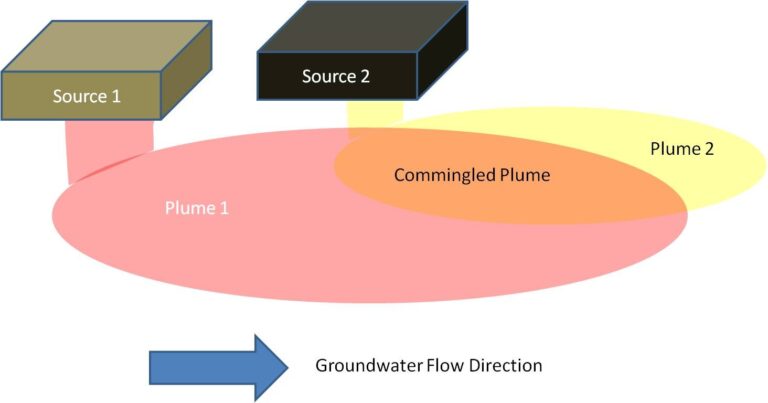
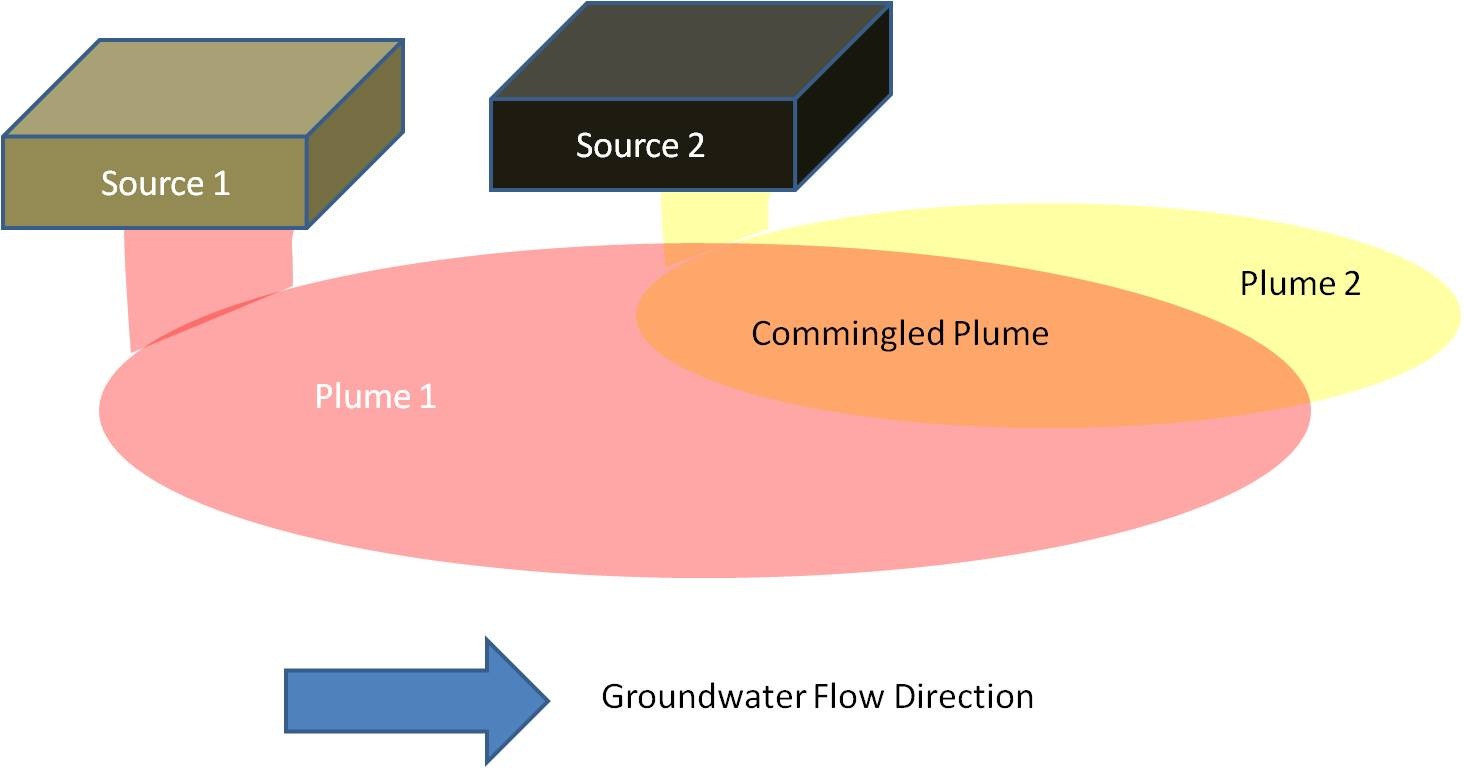
A commingled plume is the term used when two or more plumes of contaminated groundwater blend together.  The blending or commingling of groundwater plumes is a fairly common occurrence in urban or commercial settings.  A very common illustration of commingled plumes is when the groundwater beneath two corner gas stations is contaminated with releases from the underground storage tanks.  The groundwater may all move in the same general direction, but because the plumes spread or fan out as they migrate, the plumes blend together and overlap one another. 


Commingled Plumes
Commingled Plumes


Continue reading “Commingled Plumes – Who Is Responsible For The Cleanup?”

Green mean$ Green!

Can you afford not to go green?

Written by Steve Henshaw, President and CEO of EnviroForensics in collaboration with John Soderberg, PE, Esq. As seen in the September 2012 issue of the Cleaner and Launderer.

Nowadays everyone in business wants to be considered environmentally “friendly” or “green.” The retail dry cleaning industry is no exception.  In fact, given the ecological concern over perchloroethylene or “PERC”, actual or perceived, the retail dry cleaning trade has been at the forefront of the green movement.  However, there is another aspect of an environmentally friendly operation that most cleaners do not recognize, namely, that reducing consumption reduces costs.

The primary reason the trade participates in environmental conservation is because it is part of being a good corporate citizen.  Hence, most retail cleaners are only remotely aware of the potentially positive economic impact “going green” may have, independent of its positive public relations impact.  The purpose of this article is to explore that aspect as well as provide a simple method of prioritizing potentially available “environmentally friendly” or “going green” activities.

Continue reading “Green mean$ Green!”

Never is Too Late!

Insurance Companies Runoff Leaves Policyholders Vulnerable

Written by Steve Henshaw, President and CEO of EnviroForensics. As seen in the August 2012 issue of Cleaner and Launderer.

Many business owners or drycleaners and manufacturing companies know that old general liability policies can provide a defense, even an indemnity, against environmental claims.  The net effect of such a defense can translate into payment and funding of necessary site investigation, legal, and remediation costs.  To put it into business terms, a dry cleaner or other manufacturing company that is saddled with the responsibility to pay to respond to expensive environmental claims can find relief, if they can find old general liability policies that were issued before the insurance industry started adding pollution exclusion language to the policies.  To that end, a property that has been impacted with solvents or other hazardous constituents can be restored to its pre-contaminated condition.  A property that was previously considered to be an environmental liability can be turned back into an asset. Continue reading “Never is Too Late!”

What is a Hazardous Communication Plan and Why Do I Need One?

Written By Adam J. Herrmann, Project Manager, EnviroForensics in Collaboration with Stephen R. Henshaw, P.G., President & CEO, EnviroForensics.
As seen in the April 2012 issue of Cleaner & Launderer.

PDF Version

Do you have a Hazardous Communication Program (HazCom Program) in place?  If you are a dry-cleaning facility and use tetrachloroethylene (PERC) and/or other chemicals for dry-cleaning or spotting, then you should have a current and updated HazCom Program in place.

In 1983, the Occupational Safety and Health Administration (OSHA) released the Hazardous Communication Standards, which was expanded to include non-manufacturing employers in 1987.  The Hazardous Communication Standards provide employees with information regarding the hazards of the chemicals they come into contact with during work or have the potential to come into contact with (“Right to Know”).

In order to achieve a safer working environment for employees and to comply with OSHA, the implementation of a HazCom Program is mandatory when employees are or have the potential to be exposed to hazardous chemicals.  Workplace illness and injuries that are chemical related may be prevented by implementing a HazCom Program.  The HazCom Program is designed to aid in the relations between the employer and employee by opening regular lines of communication.  In addition, a HazCom Program will assist the owner/operator to avoid potential OSHA citations, violations, and related compliance costs.  Continue reading “What is a Hazardous Communication Plan and Why Do I Need One?”