By: Matthew Bono, CHMM
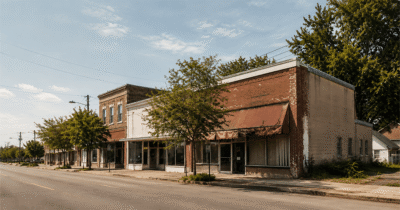
Indiana’s small towns have no shortage of vision. Across the state, historic downtowns offer buildings, streets, and public spaces that can support new housing, small businesses, local investment, and renewed community pride. What many communities need is a clearer path to reinvest in those assets and return long-underused properties to productive use.
That is the opportunity behind Indiana’s Small Town Opportunity Initiative, or STOI.
Established under HEA 1406 and administered by the Indiana Economic Development Corporation, STOI is intended to support qualified community projects that advance historic preservation and redevelop or rehabilitate distressed buildings, underutilized property, or sites where distressed buildings once stood. The program also allows redevelopment tax credits for eligible projects, including credits equal to 20% of the project cost for for-profit taxpayers and 30% for nonprofit taxpayers.
For Indiana communities looking to strengthen their downtowns, STOI represents more than a funding tool. STOI helps communities identify which older downtown properties are best positioned for reinvestment and adaptive reuse—laying the groundwork for long-term community value.
STOI Is Creating New Momentum for Downtown Revitalization
The need for small-town reinvestment is real. The STOI one-pager highlights the challenges facing many Indiana communities, including population decline, distressed downtown buildings, reduced downtown vibrancy, housing needs, and the desire to focus limited public resources where infrastructure already exists.
Downtown redevelopment is one of the most practical ways for small towns to create momentum—because it strengthens what already exists instead of spending limited resources to build outward. With infrastructure and community activity already concentrated downtown, reusing underutilized properties can deliver visible results while preserving the character people value most. STOI helps accelerate that progress by targeting the barriers that often stall reinvestment—blight, ownership challenges, and neglected historic buildings—while supporting the outcomes communities want: market‑rate housing, business growth, and vibrant downtown districts. For towns ready to act, STOI can help turn dormant properties into high‑impact community wins.
For communities that have been waiting for the right moment to act, STOI may provide the spark to begin planning.
The Opportunity Is Not Just Funding. It Is Redevelopment Readiness.
While STOI creates a new opportunity, successful redevelopment still depends on preparation.
Many of the properties best positioned for downtown revitalization are older buildings and parcels with long histories of use. Some may have housed former dry-cleaning operations, service stations, automotive repair shops, manufacturing facilities, or other commercial uses. Others may contain aging infrastructure, underground storage tanks, asbestos-containing materials, lead-based paint, or conditions that require further environmental review before redevelopment can move forward.
These factors should not be viewed as reasons to avoid downtown redevelopment. They are reasons to plan early.
A property does not need to be perfect to be worth reinvesting in. In fact, many of the most important redevelopment opportunities are the ones that require a thoughtful path forward. The key is understanding site conditions before they become barriers to financing, design, construction, or community support.
Many Older Downtown Properties Require Early Environmental Site Assessment
For municipalities, developers, nonprofits, lenders, and community foundations, environmental uncertainty can complicate redevelopment decisions. Unknown site conditions may raise questions such as:
Can the building be safely reused?
Will environmental investigation be needed before financing?
Are there vapor intrusion concerns?
Could past property uses affect future housing or commercial plans?
Will cleanup, mitigation, or regulatory coordination be required?
How should these considerations be factored into the project budget and timeline?
Answering these questions early helps stakeholders make better decisions. It also helps communities prioritize which properties are ready for redevelopment, which need additional evaluation, and which may require a more detailed strategy before moving forward.
Early preparation matters under STOI since state guidance indicates that some early-stage, nonprofit costs tied to readying a site may count toward qualified investment—if specific conditions are met.
Eligible expenditures may include costs incurred to:
- Acquire real property
- Hold real property while a project is advanced
- Prepare real property for redevelopment
The takeaway is straightforward: early-stage preparation is not separate from redevelopment success. Done well, it is part of getting a STOI project ready to move forward.
How Environmental Due Diligence Helps Prepare Properties for Reuse
Environmental due diligence gives communities, and redevelopment partners, a clearer understanding of a property before major commitments are made.
A Phase I Environmental Site Assessment can help identify recognized environmental conditions by reviewing historical property uses, regulatory records, site observations, and neighboring property concerns. If potential issues are identified, a Phase II Environmental Site Assessment or site investigation can provide more information about soil, groundwater, soil vapor, or building-related conditions.
For downtown redevelopment projects, this process can help:
- Clarify environmental conditions before acquisition or construction
- Support conversations with lenders, developers, and funding partners
- Inform project budgets and redevelopment timelines
- Identify whether remediation, vapor mitigation, or regulatory closure may be needed
- Reduce the likelihood of unexpected delays once a project is underway
- Align environmental strategy with the property’s intended future use
This kind of early planning is not just a technical step. It is part of redevelopment readiness.
When communities understand site conditions early, they are better positioned to move from concept to execution with confidence.
How EnviroForensics Supports STOI Redevelopment Efforts
EnviroForensics helps communities, developers, nonprofits, and investors navigate the environmental considerations that often come with older downtown properties.
For STOI-related redevelopment efforts, our support can include environmental site assessments and targeted investigations (including vapor intrusion), remediation planning, brownfield redevelopment strategy, regulatory guidance, responsible party research, funding support for investigation and cleanup, and coordination with project stakeholders. Additionally, EnviroForensics has experience with firms that acquire contaminated properties, manage environmental liability claims and develop properties.
The goal is not simply to identify potential problems. The goal is to help communities understand what is manageable, what steps may be needed, and how environmental planning can support the larger vision for redevelopment.
That larger vision is what STOI is about: preparing downtown properties for new housing, small business growth, historic preservation, and long-term local investment.
When environmental considerations are addressed early, they become part of a practical redevelopment plan rather than a surprise that slows momentum.
By identifying site conditions early and developing a thoughtful environmental strategy, municipalities, developers, nonprofits, and local leaders can reduce uncertainty and focus on the real work ahead: creating housing, supporting small businesses, preserving community character, and building long-term economic momentum.
At EnviroForensics, we help communities turn environmental questions into a path forward so downtown revitalization projects can move from possibility to progress.
Because when small towns are prepared to reinvest in what they already have, they are better positioned to build what comes next. Contact us today.